My hands were on fire. And yet I was surrounded by water.
I had just left The Vandenberg, where I swam over enormous radar dishes and through the sponge-encrusted wheelhouse. When I think of that dive, I remember the egg.
My dive buddy had brought it along with us. While standing along the upper deck, we cracked the egg against the shipwreck’s railing, cracking the shell open. Yolk and white floated together, congealed by the pressure of our 120-foot depth. The egg was fresh and uncooked, but it acted hard-boiled. Flicking fingers at it sent flecks of white spiraling off from the yolk like a ribbon of Jell-o. The yolk was as firm as a ping pong ball. We fed the pieces to a school of amber jacks who watched our experiment with hungry eyes.
While ascending back toward the surface, we followed the trail of a thick rope that stretched from the shipwreck below to the dazzling surface above. At the halfway mark was a beach ball-sized buoy— our indicator to take a “safety stop”— to pause for five minutes at the same depth, allowing our bodies to reacclimatize to the new pressure. Didn’t want to turn out like that egg…
That’s when my hands started burning.
They had brushed against the buoy, which was covered in a murky, scratchy substance the color of molten mustard. And that was the first time I shook hands with fire coral.
Fire coral is a kind of Hydrozoan that looks like coral but is actually its evil nemesis. It’s a fast-growing and combative underwater weed, overgrowing buoys, living corals, and other substrates, all while imposing painful necrosis on any living cells with which it comes into contact. Like my hands.
By the time I reached the surface, fiery necrosis had welted my hands with blisters that would last for days. It took three weeks before the feeling of phantom flames vanished.
Since then, I never dive without gloves. Regardless the kind of dive, the weather, or the rest of my outfit, I’m rocking gloves so that when fire coral says hello again, its greeting is painless.
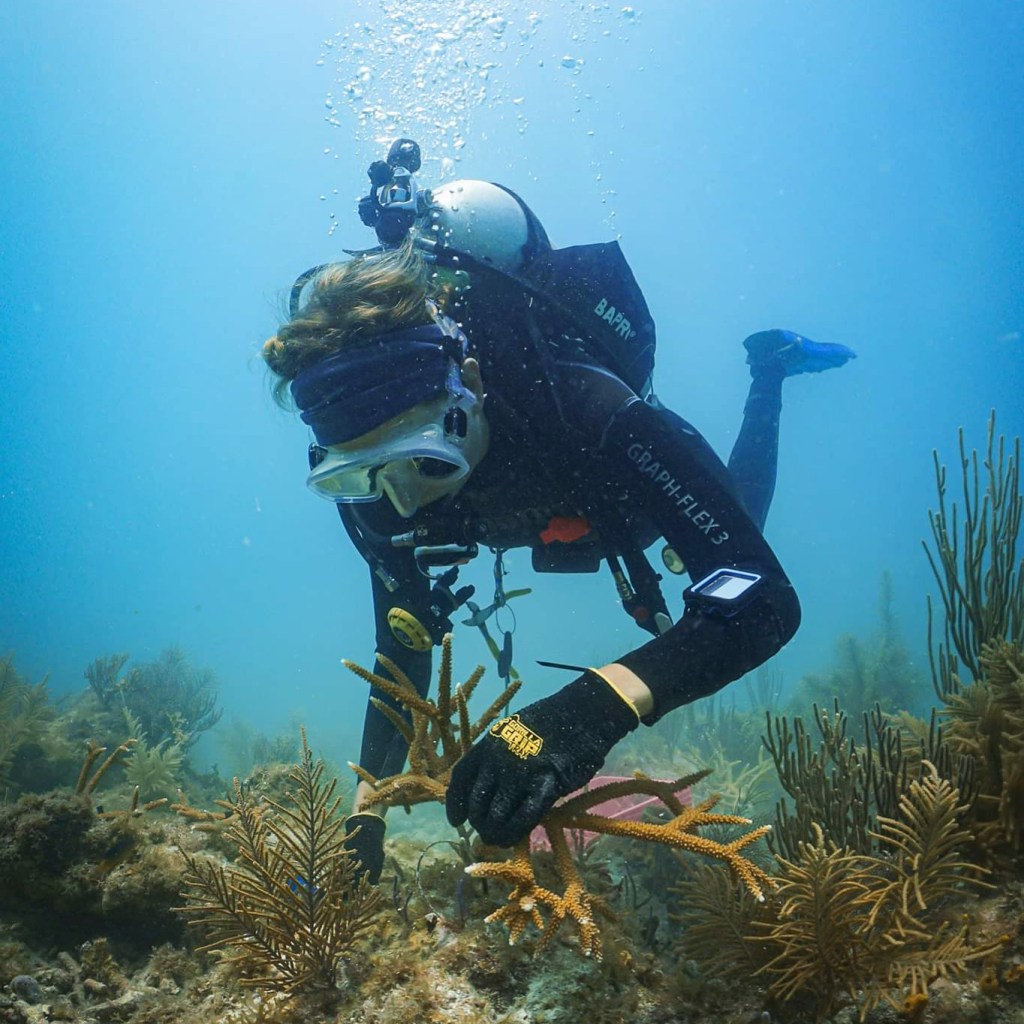

 Rachel G. Jordan | Christian Marine Biologist
Leave a comment